Tour Description
Groups accepted with a minimum of 6 pax.
The North of Portugal features an appealing combination of charming historic cities, sleepy villages, lush countryside, and an extensive and wild coastline.
This escorted tour is based in two lovely cities of the Minho region: Viana do Castelo, known as the “Pearl of the North”, and Guimarães, known as the birthplace of Portugal.
Viana do Castelo is nested at the mouth of the river Lima, on the Green Coast. It’s a seaside town with opulent Manueline and baroque buildings, crowned by the basilica of Santa Luzia, from where you get amazing views. The longest funicular in Portugal will get us there.

Ponte de Lima is the oldest town in Portugal, sited beside the tranquil waters of the river Lima
The charming medieval center with narrow winding streets has churches and impressive buildings and former manor houses. The city’s charismatic traditions and culture are present in colourful arts and crafts, and in gold filigree jewellery.
From here, we head to Vila Praia de Âncora, to a landscape of wild beaches, with endless sandy stretches backed by dunes and pine forests.
Caminha, one step away from the Spanish coast, is visible on the other side of the river Minho with Santa Tecla Hill looking back. Caminha’s traditional stone-walled houses and flower-decorated squares will be a treat!
Braga is an ancient city – was a stronghold of the Roman empire – with baroque buildings and small-town warmth. The town has a reputation as a religious destination, with its almost four dozen places of worship, like the Bom Jesus de Braga monumental staircase and sanctuary, which we’ll have the opportunity to visit. The large student population gives Braga an eclectic vibe, bringing life to the old cobbled streets.
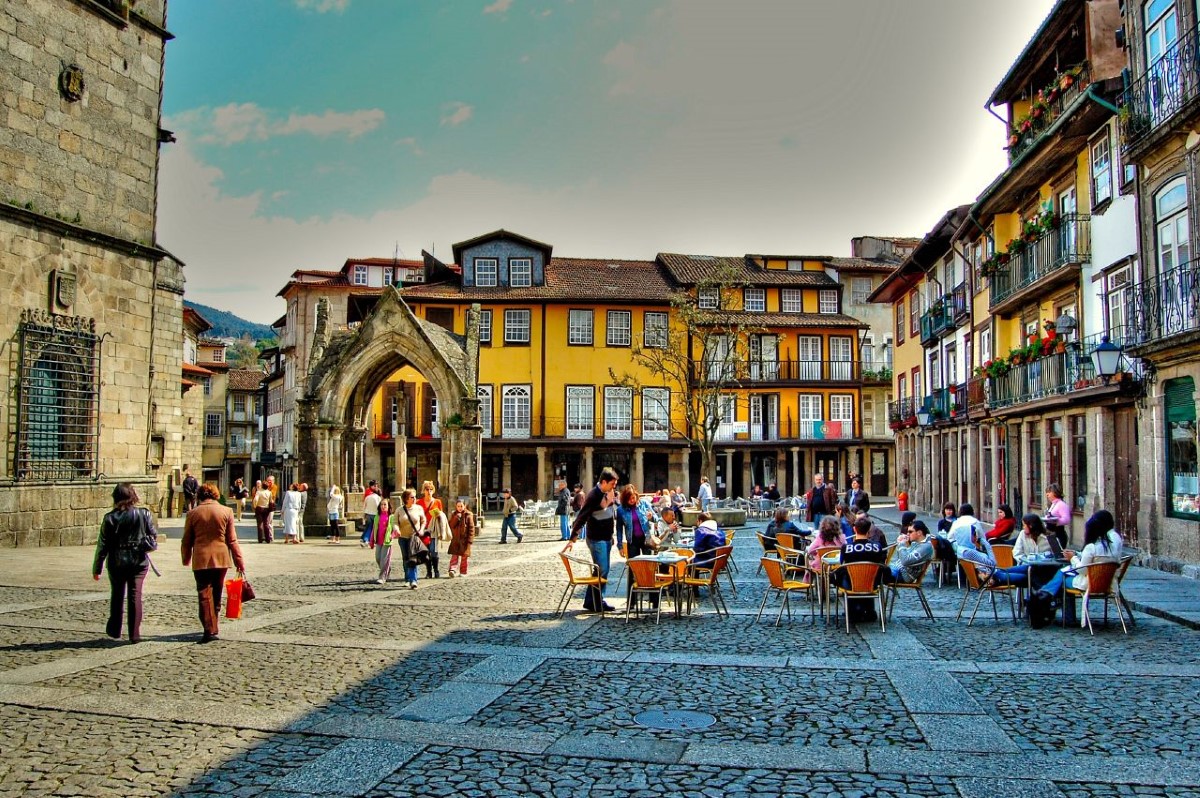
We then transfer to Guimarães, known as the birthplace of Portugal. The city has a well-preserved medieval center, enlisted as a Unesco Heritage Site. It’s a scenic entanglement of alleys and plazas, with chapels, churches, a 15th-century palace, and a castle 1000 years old.
We’ll get the chance to climb the verdant hills surrounding the town to visit Senhora da Penha, a pilgrimage site accessible by narrow tracks, perched between large granite boulders.
Fafe will be another stop, a historic city blessed by the proximity of the rivers Vizela and Ferro.
On top of all of this, we’ll have some of Portugal’s finest cuisine! The Minho region offers mouthwatering dishes, from fish straight out of the sea to earthy meat dishes and numerous other tasty delights. For the wines, try the refreshing and summery Vinho Verde!
Itinerary
Day 1 – Arrival in Porto
Arrive at Porto Airport and transfer to Viana do Castelo. If time allows an introductory walk will be offered before dinner.

Rabelo boats in Douro River . The Rabelo boat was used to transport Port Wine from the Douro Valley to the cellars near the city of Porto.
Day 2 – Viana do Castelo
Today we start by dedicating our time to explore the town that welcomes us for the next days. We’ll meander through the narrow streets of Viana do Castelo and enjoy the local life and traditions. Later on, we’ll visit the magnificent sanctuary of the Santa Luzia area, which we reach by funicular, the longest in the country.
Day 3 – Vila Praia de Âncora, Moledo & Caminha
Today we head north, to Vila Praia de Âncora. Our magnificent coastal stroll will bring us to the nearby villages that still keep their traditional traits, but have been evolving and improving the quality of life of their populations.
Vila Praia de Âncora and Moledo were in the past, small local fishing communities. Nowadays, they’re vibrant coastal beach areas that thrive on local businesses.
Caminha is one step away from the Spanish coast, visible on the other side of the Minho River with its Santa Tecla Hill looking back. Caminha’s traditional stone-walled houses and flower-decorated squares will be a treat at the end of our day!
Day 4 – Braga
Today we visit Braga and the beautiful Bom Jesus do Monte Sanctuary. Braga is one of the most innovative and sophisticated towns of the North of Portugal, a major hub that conserves its traditional and historical importance.
During the Roman occupation of the Iberian Peninsula, the town was known as “Bracara Augusta” and was the capital for the settlement of “Gallaecia”.
The Sanctuary of Bom Jesus do Monte is a notable example of a pilgrimage site with a monumental, Baroque stairway that climbs 116 meters (381 feet), classified as a UNESCO World Heritage Site.
Braga was founded in 16 BC as Bracara Augusta in honor of the Roman emperor Augustus (27 BC-14 AD)
Day 5 – Guimarães
Today we transfer to Guimarães. The town that will welcome us for the next few days is a mix of experiences, whether you prefer historic monuments and exquisite lanes, or green lush valleys and scenic viewpoints.
Its attractive medieval center has the charm of a movie set, and you can lose track of time just sitting and observing life going by.
Castle of Guimaraes is a charming and historic city and is regarded as the birthplace of Portugal
Day 6 – Guimarães
Today will be entirely dedicated to Guimarães, a charming and historic city, regarded as the birthplace of Portugal. It is a World Heritage Site, the proud birthplace of Afonso Henriques, the first independent king of Portugal.
We’ll visit one of the town’s ex LIBRIS – the Senhora da Penha, a pilgrimage site perched between large granite boulders.

The magnificient castle of the craddle of Portugal, Guimarães
Day 7 – Fafe
Today is a day that sums all the experiences of the week. We visit Fafe, a town located only 30 minutes away from Guimarães. This town, as many in the country, became the home for a majority of immigrants that returned from Brasil with large fortunes, ready to invest in big palaces and the textile industry, blessed by the proximity to the margins of the rivers Vizela and Ferro.

From Fafe to Guimarães, a World Heritage Site, the proud birthplace of Afonso Henriques
Day 8 – Departure
We say our goodbyes and head to Porto airport.